Arshile Gorky Catalogue Raisonné
Print this page

Catalogue Entry

enlarge
Charles Eisenman; © Federal Art Project Photographic Division Collection. Archives of American Art, Smithsonian Institution, Washington, D.C.
Exhibitions
Museum of Modern Art, New York, New Horizons in American Art, September 14–October 12, 1936, no. 20, as "one completed panel" from Aviation: Evolution of Forms under Aerodynamic Limitations.
Newark Museum, New Jersey, Old and New Paths in American Design, 1720–1936, November 6–December 27, 1936, as Aviation: Evolution of Forms Under Aerodynamic Limitations.
Literature
Gorky, Arshile. My Murals for the Newark Airport: An Interpretation. December 1936, discussed.
"Art Folio." Highlight (Newark, NJ) 1, no. 1 (December 1936), ill. in b/w (detail; installation view), p. 20.
Kiesler, Frederick T. [sic]. "Murals Without Walls: Relating to Gorky's Newark Project." Art Front (New York) 2 (December 18, 1936), ill. in b/w, p. 11, as "Gorky Mural".
"WPA Show Opens at Museum." The Newark Ledger (NJ), November 8, 1936, ill. in b/w, as "Aviation Evolution of Forms Under Aerodynamic Limitations".
"Events Here and There." New York Times, December 13, 1936, discussed, sec. 11, p. 12.
"Opens Exhibit Of Federal Art." Newark Evening News (NJ), November 7, 1936, discussed, p. 24.
Burrows, Carlyle. "New Mural Designs for Local Settings." New York Herald Tribune, August 8, 1937, discussed, p. F6.
Lansford, Alonzo. "Palette Painter." Art Digest (New York) 23, no. 3 (November 1, 1948), discussed p. 27.
Schwabacher, Ethel. Arshile Gorky. Introduction by Meyer Schapiro. New York: The Macmillan Company for the Whitney Museum of American Art, 1957. Monograph, fig. 32, ill. in b/w, p. 77, as "Panel of the Newark Airport Murals"; discussed pp. 70–80, as Aviation: Evolution of Forms Under Aerodynamic Limitations.
O'Connor, Francis V. "New Deal Murals in New York." Artforum (New York) 7 (November 1968), discussed pp. 45–46, as "Aviation: Evolution of Forms under Aerodynamic Limitations".
Glueck, Grace. "Art People." New York Times, December 17, 1976, discussed, p. C18, as Aviation: Evolution of Forms Under Aerodynamic Limitations.
Berman, Greta. "Abstractions for Public Spaces, 1935–1943." Arts Magazine (New York) 56, no. 10 (June 1982), discussed p. 85, as "Aviation: Evolution of Forms under Aerodynamic Limitations".
Jordan, Jim M. "The Paintings of Arshile Gorky: New Discoveries, New Sources, and Chronology." In The Paintings of Arshile Gorky: A Critical Catalogue, by Jim M. Jordan and Robert Goldwater. New York and London: New York University Press, 1982, discussed pp. 57–66, as Aviation: Evolution of Forms Under Aerodynamic Limitations.
Jordan, Jim M. "Catalogue Raisonné of Paintings." In The Paintings of Arshile Gorky: A Critical Catalogue, by Jim M. Jordan and Robert Goldwater. New York and London: New York University Press, 1982, no. 141, pp. 270–81, as Aviation: Evolution of Forms Under Aerodynamic Limitations.
Anfam, David. Abstract Expressionism. New York: Thames & Hudson, 1990, discussed p. 53, as "Aviation".
Patterson, Jody. "Modernism and Murals at the 1939 New York World's Fair." American Art (New York) 24, no. 2 (Summer 2010), discussed pp. 60–61.
Taylor, Michael R. "Arshile Gorky and Frederick Kiesler: 'Elective Affinities.'" In Frederick Kiesler: Face to Face with the Avant-Garde: Essays on Network and Impact, edited by Peter Bogner, Gerd Zillner, Frederick Kiesler Foundation. Basel: Birkhäuser, 2019, fig. 1, ill. in b/w, p. 267; discussed pp. 268–69, as "Activities on the Field".
Patterson, Jody. Modernism for the Masses: Painters, Politics, and Public Murals in 1930s New York. New Haven and London: Yale University Press, 2020, figs. 44 and 45, ill. in b/w, p. 107, as "Activites on the Field and Mechanics of Flying, from Aviation: Evolution of Forms Under Aerodynamic Limitations (Newark Airport Murals)".
[unknown title]. c. 1936, discussed.
Gorky, Arshile. My Murals for the Newark Airport: An Interpretation. c. 1936, discussed.
Gorky, Arshile. Arshile Gorky, Murals for Newark Airport: General Description (Abridged). c. 1936, discussed.
Gorky, Arshile. My Murals for the Newark Airport: An Interpretation (Abridged). c. 1936, discussed.
Notes
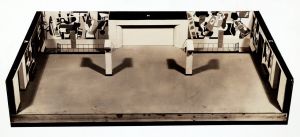
Commentary

In August 1935, Gorky was assigned to the Mural Division of the Works Progress Administration's newly established Federal Art Project (WPA/FAP). In January 1936, his first commission for a 720-square-foot, single panel, aviation-themed mural for the Administration Building at Floyd Bennett Field in Brooklyn, New York, was transferred to the newly opened Administration Building at Newark Airport, New Jersey. This was, in part, due to then New York mayor, Fiorella H. La Guardia's (1882–1947), criticism of Gorky's studies for Floyd Bennett Field. As quoted in the New York Herald Tribune on the opening of the Federal Art Project Gallery's exhibition, Murals for Public Buildings, in December 1935: "[Mayor La Guardia] attended the opening . . . and found that several of the murals scheduled to adorn public buildings in New York City were beyond his comprehension. . . . Mr. Gorky told the Mayor that the abstractionist did not use 'old fashioned colors,' tried to show all sides of an object at the same time, and viewed a round ball as flat. The Mayor wrinkled his brow. 'I'm a conservative in my art, as I am a progressive in my politics,' he said. 'That’s why perhaps I cannot understand it.'"1

Gorky's revised aviation-themed commission—titled Aviation: Evolution of Forms Under Aerodynamic Limitations, by the WPA/FAP, and exhibited as such in September 1936—consisted of a ten-panel mural cycle for the building's second-floor foyer, executed in oil on canvas, and measuring approximately 1,530 square feet. By December 1936, Gorky had assigned distinct titles for each of the four walls on which the ten panels were installed: Activities on the Field (north wall), Modern Aviation (south wall), Mechanics of Flying (east wall), and Early Aviation (west wall). Each wall displayed a total of two panels, with the exception of the four-panel south wall (see D0642, D0643, D0644, and D0641).2 The known preparatory drawings for the project (see related work) and the two remaining panels (P141v and P141w) are catalogued under Gorky's titles.

Gorky's final designs for Newark stemmed, in large part, from his earlier designs for Floyd Bennett, but no longer incorporated the photographs of Wyatt Davis (see D0635 and D0638). Due to their size, the ten panels were painted off-site in the seventh-floor workshop of the FAP's midtown headquarters at 6 East 39th Street. Following a failed first attempt to affix the panels to the walls, in June 1937, the completed mural cycle was unveiled to the public, secured by a newly developed fixative formula of "lead white-resin varnish."2 According to an internal WPA memo dated June 25, 1937, a day after the murals' formal acceptance: "Mr. Gorky has a few minor changes to make now that they are all installed. It was [also] decided that the walls between the mural paintings are to be white, the pillars in the center of the room light gray."3 In an unpublished statement submitted in December 1936, at the request of the WPA/FAP's Washington office, Gorky offers: "In these times, it is of sociological importance that everything should stand on its own merit, always keeping its individuality. I much prefer that the mural fall out of the wall, than harmonize with it. Mural painting should not become architecture. . . . [I]t should never be confused with walls, windows, doors, or any other anatomical blueprints."4

Gorky's murals were met with mixed reviews. At the request of the WPA, Alfred H. Barr Jr. (1902–1981), director of the Museum of Modern Art, submitted a written statement in defense of Gorky's designs, observing: "Any conservative or banal or reactionary decorations would be extremely inappropriate. It is dangerous to ride in an old-fashioned airplane. It is inappropriate to wait and buy one's ticket surrounded by old-fashioned murals."5 Gorky, notably, never traveled by airplane.

Between April 1941 and March 1948, the Administration Building was requisitioned by the War Department. During this time, all ten of Gorky's panels were concealed by structural remodeling and repainting. In 1972, under the direction of Ruth Bowman (1923–2018), then a curator at New York University’s Art Collections, traces of canvas thread were discovered beneath fourteen layers of paint. In late 1976, after extensive restoration work, both east wall panels were recovered (P141v and P141w). They are the only two remaining panels. 

There are three known photographs of the completed murals as installed at Newark, in which, only four of the ten panels are pictured (P141w; two of the four-panel south wall series, Modern Aviation; and one of the two-panel north wall series, Activities on the Field).6 The west wall, Early Aviation, is the only wall for which there is no visual documentation, aside from the miniature gouache studies in the lost model (see supplementary images). In Gorky's description, Early Aviation "sought to bring into elemental terms the sensation of the passengers in the first balloon to the wonder of the sky around them and the earth beneath."7

1. “W.P.A. Murals are Too Much for LaGuardia: ‘If Abstractions Are Art, I Belong to Tammany,’ He Says at Gallery Debut,” New York Herald Tribune, December 28, 1935.

2. Arshile Gorky, "My Murals for the Newark Airport: An Interpretation," December 1936, handwritten manuscript, AGF Archives (Gorky 1936).

3. The updated fixative formula was developed by the WPA's Technical Services division. On the failed first adhesion, see: Ruth Bowman, "Arshile Gorky's Aviation Murals Rediscovered," in Bowman, Murals without Walls: Arshile Gorky’s Aviation Murals Rediscovered, exh. cat. (Newark, N.J.: Newark Museum, 1978), 39. See also: Letter from Arshile Gorky to Vartoosh Mooradian, 1937, Arshile Gorky/Mooradian Archive, Eastern Diocese of the Armenian Church of America, New York; Arshile Gorky to Vartoosh Mooradian, 1937, in Matthew Spender, ed., The Plow and the Song: A Life in Letters and Documents, trans. Father Krikor Maksoudian (Zurich: Hauser & Wirth Publishers, 2018), 148. The murals' acceptance date is confirmed by: Olive M. Lyford (Special Representative, WPA/FAP, N.J.), "Newark Airport Projects [minutes for meeting held on June 24, 1937]," June 25, 1937, AGF Archives.

4. See Gorky 1936 for additional information about the origins of this written statement for the WPA/FAP, which was only published posthumously, and for information about the various edited versions of it that are known to exist, including: Gorky c. 1936bGorky c. 1936c, and Gorky c. 1936d. Gorky, iv. 

5. Letter from Alfred H. Barr Jr. to Olive M. Lyford (Special Representative, WPA/FAP, N.J.), October 14, 1936, AGF Archives.

6. The three photographs are dated April 17, 1940, and credited to a WPA photographer identified only as "Allen"; the only known prints are held in the Newark Museum Archives. Gift of Dorothy C. Miller, 1979 (Object numbers: 79.850, 79.851, and 79.858).

7. Gorky, vi.

Aviation: Evolution of Forms Under Aerodynamic Limitations, 1935–37, P141. Lost model for Aviation: Evolution of Forms Under Aerodynamic Limitations, second-floor foyer, Newark Airport Administration Building.
Lost model for Aviation: Evolution of Forms Under Aerodynamic Limitations, second-floor foyer, Newark Airport Administration Building.
Photo: © Arshile Gorky Estate Archive
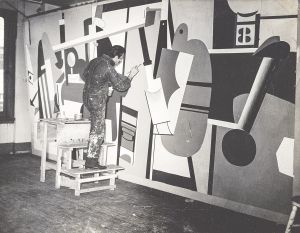
Aviation: Evolution of Forms Under Aerodynamic Limitations, 1935–37, P141. Gorky at work on Activities on the Field, from Aviation: Evolution of Forms Under Aerodynamic Limitations, in the WPA/FAP studio, 1936. The panel was ultimately installed on the north wall of the second-floor foyer, Newark Airport Administration Building.
Gorky at work on Activities on the Field, from Aviation: Evolution of Forms Under Aerodynamic Limitations, in the WPA/FAP studio, 1936. The panel was ultimately installed on the north wall of the second-floor foyer, Newark Airport Administration Building.
© Federal Art Project Photographic Division Collection. Archives of American Art, Smithsonian Institution, Washington, D.C.
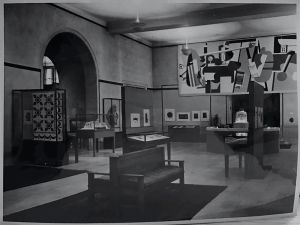
Aviation: Evolution of Forms Under Aerodynamic Limitations, 1935–37, P141. Installation photograph of Old and New Paths in American Design, 1720–1936 at Newark Museum, November 6–December 27, 2021. Visible is Gorky's completed panel, Activities on the Field, from Aviation: Evolution of Forms Under Aerodynamic Limitations. The panel was ultimately installed on the north wall of the second-floor foyer, Newark Airport Administration Building.
Installation photograph of Old and New Paths in American Design, 1720–1936 at Newark Museum, November 6–December 27, 2021. Visible is Gorky's completed panel, Activities on the Field, from Aviation: Evolution of Forms Under Aerodynamic Limitations. The panel was ultimately installed on the north wall of the second-floor foyer, Newark Airport Administration Building.
Unknown WPA photographer; © Newark Museum Archives
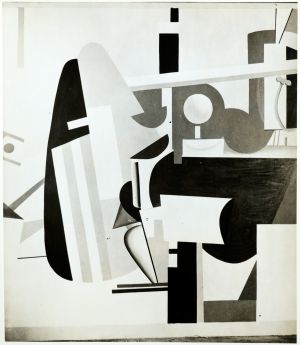
Aviation: Evolution of Forms Under Aerodynamic Limitations, 1935–37, P141. Activities on the Field, from Aviation: Evolution of Forms Under Aerodynamic Limitations, in the WPA/FAP studio, 1936. The panel was ultimately installed on the north wall of the second-floor foyer, Newark Airport Administration Building.
Activities on the Field, from Aviation: Evolution of Forms Under Aerodynamic Limitations, in the WPA/FAP studio, 1936. The panel was ultimately installed on the north wall of the second-floor foyer, Newark Airport Administration Building.
Photo: © Arshile Gorky Estate Archive
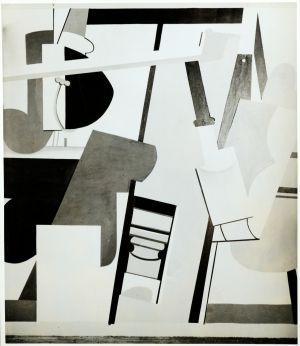
Aviation: Evolution of Forms Under Aerodynamic Limitations, 1935–37, P141. Activities on the Field, from Aviation: Evolution of Forms Under Aerodynamic Limitations, in the WPA/FAP studio, 1936. The panel was ultimately installed on the north wall of the second-floor foyer, Newark Airport Administration Building.
Activities on the Field, from Aviation: Evolution of Forms Under Aerodynamic Limitations, in the WPA/FAP studio, 1936. The panel was ultimately installed on the north wall of the second-floor foyer, Newark Airport Administration Building.
Photo: © Arshile Gorky Estate Archive
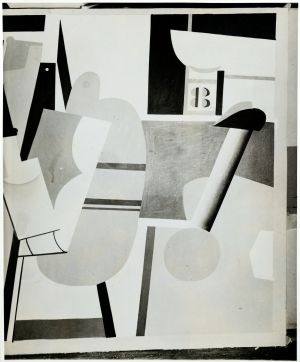
Aviation: Evolution of Forms Under Aerodynamic Limitations, 1935–37, P141. Activities on the Field, from Aviation: Evolution of Forms Under Aerodynamic Limitations, in the WPA/FAP studio, 1936. The panel was ultimately installed on the north wall of the second-floor foyer, Newark Airport Administration Building.
Activities on the Field, from Aviation: Evolution of Forms Under Aerodynamic Limitations, in the WPA/FAP studio, 1936. The panel was ultimately installed on the north wall of the second-floor foyer, Newark Airport Administration Building.
Photo: © Arshile Gorky Estate Archive
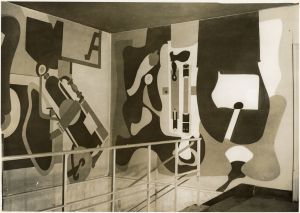
Aviation: Evolution of Forms Under Aerodynamic Limitations, 1935–37, P141. Activities on the Field (left) and Mechanics of Flying (right; P141w), from Aviation: Evolution of Forms Under Aerodynamic Limitations, northeast corner of the second-floor foyer, Newark Airport Administration Building. Photograph taken April 17, 1940. Gelatin silver print, 10 x 8 in (25.4 x 20.3 cm). Gift of Dorothy C. Miller, 1979; Collection of The Newark Museum of Art (79.850).
Activities on the Field (left) and Mechanics of Flying (right; P141w), from Aviation: Evolution of Forms Under Aerodynamic Limitations, northeast corner of the second-floor foyer, Newark Airport Administration Building. Photograph taken April 17, 1940. Gelatin silver print, 10 x 8 in (25.4 x 20.3 cm). Gift of Dorothy C. Miller, 1979; Collection of The Newark Museum of Art (79.850).
Photo: Allen; © Newark Museum Archives
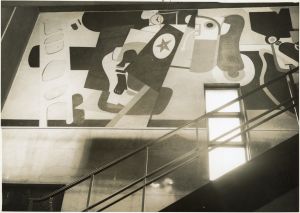
Aviation: Evolution of Forms Under Aerodynamic Limitations, 1935–37, P141. Activities on the Field, from Aviation: Evolution of Forms Under Aerodynamic Limitations, north wall of the second-floor foyer, Newark Administration Building. Photograph taken April 17, 1940. Gelatin silver print, 10 x 8 in (25.4 x 20.3 cm). Gift of Dorothy C. Miller, 1979; Collection of The Newark Museum of Art (79.851).
Activities on the Field, from Aviation: Evolution of Forms Under Aerodynamic Limitations, north wall of the second-floor foyer, Newark Administration Building. Photograph taken April 17, 1940. Gelatin silver print, 10 x 8 in (25.4 x 20.3 cm). Gift of Dorothy C. Miller, 1979; Collection of The Newark Museum of Art (79.851).
Photo: Allen; © Newark Museum Archives
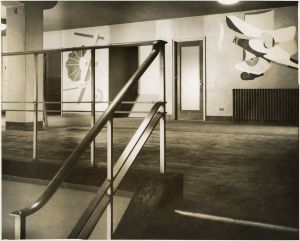
Aviation: Evolution of Forms Under Aerodynamic Limitations, 1935–37, P141. Modern Aviation, two panels from Aviation: Evolution of Forms Under Aerodynamic Limitations, south wall of the second-floor foyer, Newark Airport Administration Building. Photograph taken April 17, 1940. Gelatin silver print, 10 x 8 in (25.4 x 20.3 cm). Gift of Dorothy C. Miller, 1979; Collection of The Newark Museum of Art (79.858).
Modern Aviation, two panels from Aviation: Evolution of Forms Under Aerodynamic Limitations, south wall of the second-floor foyer, Newark Airport Administration Building. Photograph taken April 17, 1940. Gelatin silver print, 10 x 8 in (25.4 x 20.3 cm). Gift of Dorothy C. Miller, 1979; Collection of The Newark Museum of Art (79.858).
Photo: Allen; © Newark Museum Archives

Aviation: Evolution of Forms Under Aerodynamic Limitations, 1935–37, P141. Lost model for Aviation: Evolution of Forms Under Aerodynamic Limitations, second-floor foyer, Newark Airport Administration Building. Detail of the "South Wall," or Modern Aviation.
Lost model for Aviation: Evolution of Forms Under Aerodynamic Limitations, second-floor foyer, Newark Airport Administration Building. Detail of the "South Wall," or Modern Aviation.
Photo: Courtesy the Frances Mulhall Achilles Library and Archives, Whitney Museum of American Art, New York
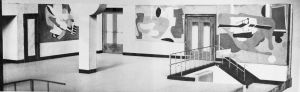
Aviation: Evolution of Forms Under Aerodynamic Limitations, 1935–37, P141. Lost model for Aviation: Evolution of Forms Under Aerodynamic Limitations, second-floor foyer, Newark Airport Administration Building. Detail of the "West Wall," or Early Aviation.
Lost model for Aviation: Evolution of Forms Under Aerodynamic Limitations, second-floor foyer, Newark Airport Administration Building. Detail of the "West Wall," or Early Aviation.
Photo: Courtesy the Frances Mulhall Achilles Library and Archives, Whitney Museum of American Art, New York
Related Work

Theme: Mural

loading