
 previous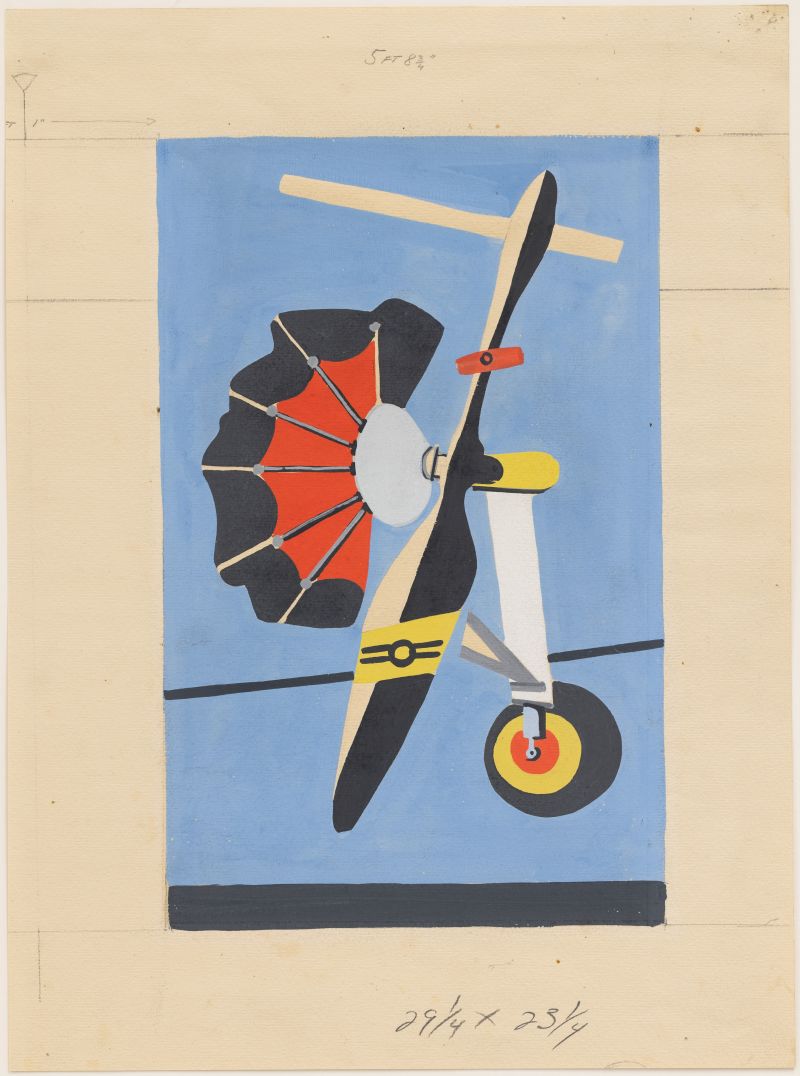
Verso not inscribed
Verso, in blue ink, upper left [not in artist's hand]: [illegible]
The verso inscription information and marking are known from the records of the Arshile Gorky Foundation.
On loan: Art Institute of Chicago, January 15, 1964–September 19, 1984.
On loan: Fundação Calouste Gulbenkian, Lisbon, 1985–present.
Commentary
The drawing is a preparatory work for the third of four panels that formed the south wall of Gorky's Newark Airport mural cycle, which he completed for the Works Progress Administration's Federal Art Project (WPA/FAP) between 1935 and 1937 (see P141, P141v and P141w).
Although the FAP gave Gorky’s Newark commission the overarching title of Aviation: Evolution of Forms Under Aerodynamic Limitations, by December 1936, Gorky had selected his own titles for each of the four walls on which the panels were suspended (North, South, East, and West). The four-panel south wall series was designated Modern Aviation.1
In a written interpretation, submitted in December 1936 at the request of the WPA's Washington Office, Gorky offers the following description of the composition: "The first three panels of Modern Aviation contain the anatomical parts of autogyros in the process of soaring into space, and yet with the immobility of suspension [see also D0642 and D0643].… I have used arbitrary colors and shapes, the wing is black the rudder yellow, so as to convey the sense that these modern gigantic implements of man are decorated with same fanciful yet utilitarian sense of play that children use in coloring their kites. In the same spirit the engine becomes in one place like the wings of a dragon, and in another, the wheels, propellor, and motor take on the demonic speed of a meteor clearing the atmosphere."2
The drawing was a gift to Gorky’s nephew Karlen Mooradian (1935–1990), the only son of his younger sister Vartoosh Mooradian (née Adoian; 1906–1991). According to Karlen, he received the drawing by mail in Chicago, where the Mooradian family had moved in November 1936. In his words: "It was during the war and… I longed for pictures of fighter planes in action.… In my next letter I asked [Gorky] to send me some pictures of planes. There arrived in the mail soon thereafter four gouaches of spatially dissected airplanes, highly abstract and intellectually advanced."3 Gorky himself refers to sending drawings to Karlen in several letters of 1937 and 1938.4 According to Vartoosh, “Numbers I [D0642] and IV [D0641] both arrived matted together in a single frame, while II [D0643] and III [D0644] were separately framed…. And earlier [Gorky] had given me two additional gouaches, now lost. They too formed part of the Newark airplane series. One approximated number III [D0644] in terms of the propeller with round configuration, the other seemed similar to number I [D0642] with reddish tone."5
1. Arshile Gorky, "My Murals for the Newark Airport: An Interpretation," December 1936, handwritten manuscript, vii-viii, AGF Archives.
2. Ibid.
3. Karlen Mooradian, "Arshile Gorky: Image from Armenia," in An Exhibition of Drawings by Arshile Gorky (Oklahoma City: Oklahoma Art Center, 1973), 14.
4. Arshile Gorky to Vartoosh Mooradian, [month unknown] 18, 1937; January 1, 1938; February 28, 1938; April 18, 1938; and May 10, 1938, in Arshile Gorky/Mooradian Archive, Eastern Diocese of the Armenian Church of America, New York. Arshile Gorky to Vartoosh Mooradian, [month unknown] 18, 1937; January 1, 1938; February 28, 1938; April 18, 1938; and May 10, 1938, in Matthew Spender, ed., Arshile Gorky: The Plow and the Song: A Life in Letters and Documents, trans. Father Krikor Maksoudian (Zurich: Hauser & Wirth Publishers, 2018), 154–63.
5. Vartoosh Mooradian, interview by Karlen Mooradian, Arshile Gorky/Mooradian Archive, Eastern Diocese of the Armenian Church of America, New York; Vartoosh Mooradian, "Recollections of Vartoosh Mooradian," interview by Karlen Mooradian, The Many Worlds of Arshile Gorky (Chicago: Gilgamesh, 1980), 45.
Theme: Mural
