Catalogue Entry

Reverse, in pencil, on a section of the canvas folded around the upper stretcher bar [possibly in artist's hand]: CHARRED BELOVed
Reverse, in pencil, on vertical stretcher bar [not in artist's hand]: Charred Beloved [sideways]
The reverse inscription information and marking are known from a photograph provided by the National Gallery of Canada, Ottawa.
Commentary
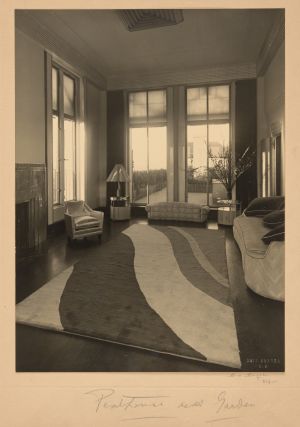
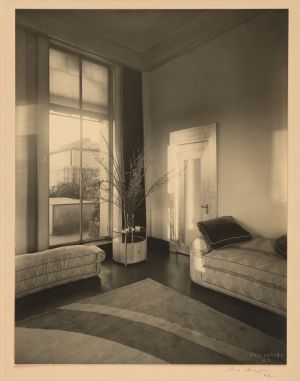
Shortly after Gorky's studio in Sherman, Connecticut, was destroyed by fire in mid-January 1946, the art collectors Kathrin (1900–1984) and Walter Hochschild (1900–1983) offered him use of the ballroom in their penthouse apartment located at 1200 Fifth Avenue (see supplementary images).1 In this temporary studio, Gorky created four paintings (P305, P306, P307, and P371), three of which were sent to Julien Levy Gallery in New York, where they were exhibited that April.2 This painting is the second work on the checklist: Charred Beloved No. 2. It was titled by Gorky in anticipation of Levy's exhibition, likely through a process of free association similar to the one that he and André Breton (1896–1966) had first experimented with a year earlier (see commentary for P287). The painting's overall composition is closely referenced in one known drawing (see D1203).
The devastating studio fire was unexpectedly liberating for the artist as Agnes "Mougouch" Gorky (1921–2013) later explained. "The fire was awful, breathtaking, but I have never seen Gorky so strong, so calm, so free as he was that next day. The studio was destroyed but the paintings, he said, were all in him. He would make better ones."3 Gorky himself would later comment, "sometimes it is very good to have everything cleaned out like that, and be forced to begin again."4
Writing to a friend in early February about the unusual situation, Mougouch noted: "Gorky is working very hard. I send him off in the morning with his lunch pail so that he won't have to come down from his tower until dark. Surely the only man who goes off to work in a penthouse ballroom toting his lunch in a little black pail—a sky miner—He's strangely happy. The Ballroom will do till we find something else—its very far—101st & 5th but the people have been very nice & leave him entirely to himself. . . ."5
1. According to a 1930s description of the interior, a decade before Gorky’s use of the room: “Ballroom had huge white tweed couch, 2-3 small smoke colored upholstered chairs, huge rug of white, smoke + pink + beige stripes, 2 long upholstered benches to match couch, floor-to-ceiling windows opening onto terrace." Photographs of the Kathrin & Walter Hochschild Residence at 1200 Fifth Avenue (New York, NY), 1930s. Avery Architectural and Fine Arts Library, Columbia University, New York.
2. Julien Levy Gallery, New York, Arshile Gorky: Paintings, April 9–May 4, 1946.
3. Agnes Gorky Phillips, "Unpublished Critique of Ethel Schwabacher's Biography," c. 1957, in Matthew Spender, ed., Arshile Gorky: The Plow and the Song: A Life in Letters and Documents (Zurich: Hauser & Wirth Publishers, 2018), 533; see also: Letter from Agnes "Mougouch" Gorky to Jeanne Reynal, late January 1946, in ibid, 372.
4. Arshile Gorky, as quoted in Talcott B. Clapp, "A Painter in a Glass House," Sunday Republican Magazine (February 29, 1948): 3.
5. Letter from Agnes "Mougouch" Gorky to Jeanne Reynal, February 5, 1946, in Spender, ed., 375.