
Catalogue Entry
Reverse, center stretcher bar: A. Gorky
Front, lower right [by Agnes Gorky Phillips]: A Gorky / [paraph]
The reverse is covered by a backing board. The inscription on the stretcher bar is known from the records of the Hirshhorn Museum and Sculpture Garden, Smithsonian Institution, Washington, D.C.
Commentary
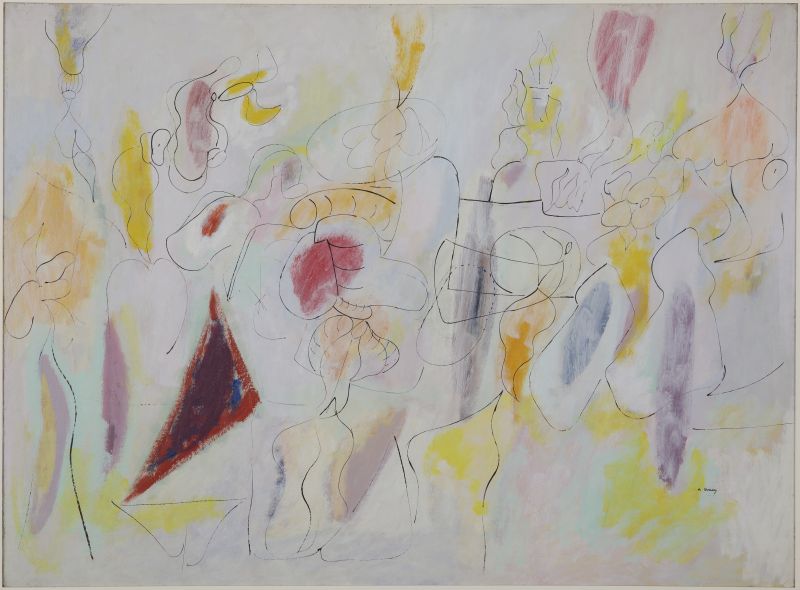
In July 1943, the Gorkys left New York with their three-month-old daughter Maro and took up residence in the recently acquired Lincoln, Virginia, home of Agnes "Mougouch" Gorky's parents, Esther (1896–1990) and John H. Magruder II (1889–1963). The young family enjoyed an extended stay at Crooked Run Farm, as it was known, in large part because Gorky was so taken with his natural surroundings. By November, when they returned to New York, Gorky had created over one hundred pencil and crayon drawings. The painting's overall composition is closely referenced in several known drawings (see related work).
According to Mougouch (1921–2013), Gorky "immediately liked Virginia. . . . He arrived with no paints and no easel, as we couldn't fit much into the car. All he took were wax crayons and watercolors and buckets of paper. And that's what he feverishly worked on all summer. He cleaned up the barn and decorated it with old horse bones that he found in the fields. It was the first time that he saw the seasons in America come and go."1 As Mougouch later explained to a friend, the 110-acre farm and its enveloping landscape were a revelation to Gorky: "He was again a small child . . . and his vision was clear and untrammeled by habit. He made only drawings. . . . A drawing is more direct and automatic, or should be, to have the lyrical freshness that a drawing should have, like a poem. . . . This summer was the real release of Gorky. He was able to discover himself and what he has done is to create a world of his own but a world equal to nature with the infinite complexities of nature and yet sweet, secretive and playful as nature is."2
In an April 1944 article for Harper's Bazaar, the Museum of Modern Art curator James Johnson Sweeney (1900–1986) wrote of how the artist had "look[ed] into the grass" that summer, in practice and spirit, resulting in a "freshness and personalization of idiom which Gorky had never previously approached, and a new vocabulary of forms on which he is at present drawing for a group of large oil paintings."3
The painting is an early example of Gorky's use of a liner brush, the long-haired, fine-tipped paintbrush preferred by sign painters for making extremely thin lines of uniform weight. As a teenager, Willem de Kooning (1904–1997) learned about this tool while apprenticed to a decorating firm in Rotterdam, the Netherlands, and takes credit for introducing it to Gorky. As de Kooning later recalled, Gorky was frustrated by not being able to transfer the delicate lines of his drawings into the compositions of his paintings with the large brushes he was using. "Once he bought [a liner brush], de Kooning remembers, Gorky spent the day in ecstasy painting long thin lines."4
1. Cosima Spender, interview with Agnes "Mougouch" Gorky Fielding, in Tate Etc. (Issue 18: Spring 2010), https://www.tate.org.
2. Letter from Mougouch Gorky to Nathalie Campbell, December 12, 1943, in Matthew Spender, ed., Arshile Gorky: The Plow and the Song: A Life in Letters and Documents (Zurich: Hauser & Wirth Publishers, 2018), 290.
3. James Johnson Sweeney, "Five American Painters," Harper's Bazaar (April 1944), reprinted in Ethel Schwabacher, "Arshile Gorky," in Arshile Gorky Memorial Exhibition, exh. cat. (New York: Plantin Press, 1951), 30.
4. Hayden Herrera adds that the artist Gabor Peterdi (1915–2001) also took credit for introducing the liner brush to Gorky. Arshile Gorky: His Life and Work (New York: Farrar, Straus and Giroux, 2003), 434. Mark Stevens and Annalyn Swan, de Kooning: An American Master (New York: Alfred A. Knopf, 2016), 105. See also: Harold Rosenberg, Arshile Gorky: The Man, The Time, The Idea (New York: Horizon Press, 1962), 68; William Seitz, "IV: Nature (c. 1942–48)," in Arshile Gorky: Paintings, Drawings, Studies, exh. cat. (New York: Museum of Modern Art, 1962), 34–5.